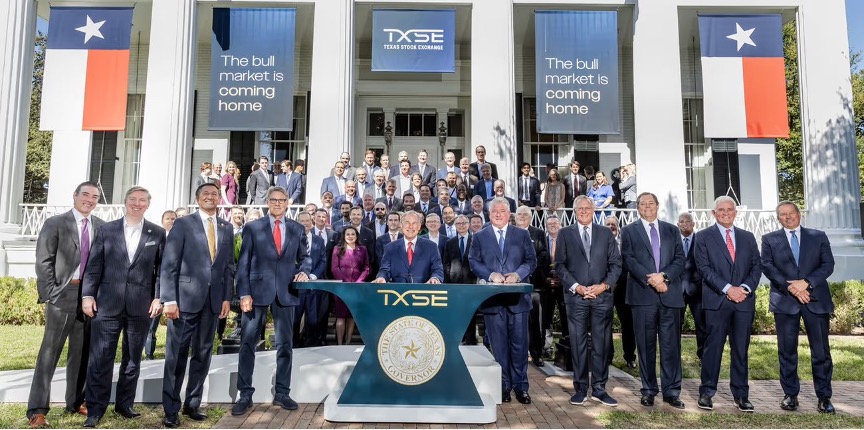
Energy Transfer LP is leaving the New York Stock Exchange after nearly three decades on Wall Street, and it isn’t going alone. The Dallas pipeline company confirmed this month that its common units, along with three affiliated Sunoco and USA Compression entities, will shift their primary listings to the Texas Stock Exchange starting October 5. Ticker symbols stay unchanged: ET, SUN, SUNC and USAC. Together, the four companies carry a combined market value approaching $100 billion, based on Energy Transfer’s announcement of the transfer.
Behind the move sits a name that has shaped Energy Transfer for nearly thirty years. Kelcy Warren, Energy Transfer’s executive chairman and co-founder, holds roughly a 30% stake in TXSE Group Inc., the exchange’s parent company, according to the Wall Street Journal. That ownership position makes Warren the largest shareholder in an exchange that just claimed its first genuine corporate defection from an incumbent that has dominated stock listings for more than two centuries.
TXSE Lands Its First Major Win
TXSE Chairman and CEO James Lee did not undersell the moment. “The movement of primary listings out of New York and into Texas has begun,” Lee said in a statement reported by The Dallas Morning News. “This is the beginning of a larger trend that will reshape the broader listings landscape in the United States for decades and position Texas as a global capital markets leader.”
That same description, “a watershed moment for capital markets, not just in Texas, but nationally,” appeared in coverage from the Dallas Business Journal, which noted the four companies, all part of the Energy Transfer family, had already redomiciled from Delaware to Texas earlier this year, joining Exxon Mobil, Tesla and other large companies that relocated their legal homes to the state.
TXSE itself only reached full trading operations in July, roughly eighteen months after its 2024 launch. More than $275 million in outside financing was raised before the exchange opened, with backers that include BlackRock, Citadel Securities and JPMorgan Chase. Two exchange-traded funds from Texas Capital had already made the jump before Energy Transfer’s announcement arrived.
What Kelcy Warren’s Stake Means for Texas Finance
Kelcy Warren co-founded Energy Transfer in 1996 with roughly 200 miles of East Texas pipeline. The company he built now covers 44 states and about 140,000 miles of pipe, figures confirmed on Energy Transfer’s own investor site.
His name carries weight well beyond Dallas. Hart Energy inducted him into its 2023 Hall of Fame.
Warren’s holdings are also tracked by the Bloomberg Billionaires Index, a reflection of how closely his business decisions get followed outside the pipeline industry itself.
That visibility cuts both ways for TXSE. Index providers S&P Dow Jones Indices, MSCI and FTSE Russell each updated their rules this year so TXSE-listed companies would qualify for major benchmarks. That change clears a hurdle that had made a Dallas listing a harder sell for larger firms. Even so, one analyst told Reuters, speaking anonymously to discuss market structure, that unseating the “duopoly” NYSE and Nasdaq hold on corporate listings “isn’t as simple as it sounds” and that “previous attempts to do just this haven’t gained much traction.”
Texas Capital Bancshares announced separately on September 14 that it plans to move its own primary listing from Nasdaq to TXSE this November, a sign that Energy Transfer’s exit from the NYSE may not stand alone for long. For Kelcy Warren, the moment doubles as validation. The exchange he backed as a founding investor just landed the largest corporate win of its short history, carried in by the very company he has led since 1996.